
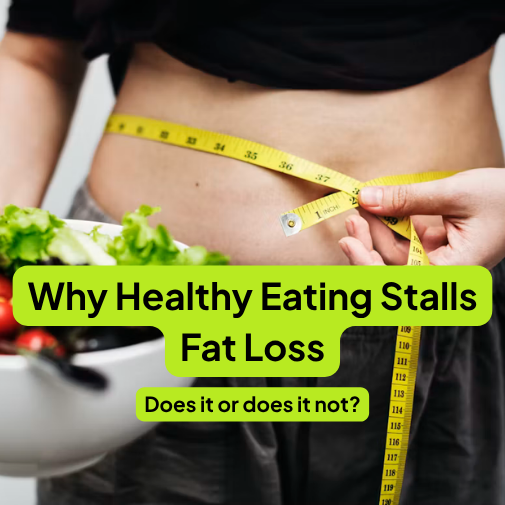
The Science of the Fat-Loss Stall and Why Healthy Eating May Not Be Working for You.
The clean eating paradox and why your salad is treading water.
You have swapped the processed snacks for kale, traded the soda for kombucha, and your pantry is a temple of organic labels. Yet the scale will not budge. This is the “clean eating paradox”, a frustrating plateau where food quality is high but fat loss is nonexistent.
Fat loss is governed by energy balance. That is not in question. But energy balance is not just a matter of willpower, it is a dashboard of physiological adaptations, psychological blind spots, and the physical structure of the food itself. To break the stall, you have to look past the “clean” label and into the data.
The invisible surplus, and why memory is a terrible calorie counter
The human brain is a master of creative accounting when it comes to food. In a landmark study, Lichtman and colleagues (1992) studied 10 “diet-resistant” individuals, nine women and one man, who claimed they could not lose weight despite eating fewer than 1,200 calories a day.
Using doubly labeled water, the gold standard for measuring energy expenditure, the researchers found a large gap between perception and reality. These subjects underreported their actual food intake by an average of 47 percent and overreported their physical activity by 51 percent. This was not intentional deception, it was a genuine psychological discounting of the energy they consumed.
Their metabolism was not the problem. No subject’s total energy expenditure or resting metabolic rate fell more than 10 percent below the predicted value (Lichtman et al., 1992). The stall was driven by a mismatch between perceived and actual intake, not a broken metabolism.
Small bites, big numbers, and the energy density trap
The health halo often blinds people to calorie density, the amount of energy packed into a given weight of food. A small amount of a healthy fat can carry the caloric weight of a full meal. Olive oil runs roughly 4,000 calories per pound, one of the most energy-dense foods you can buy.
To put that in perspective, a high-volume vegetable might contain only about 30 calories per 100 grams, while a dense item like dark chocolate packs closer to 550 calories per 100 grams. Foods low in energy density, vegetables, melons, berries, lean fish, take up real stomach space and trigger fullness. Foods high in energy density, nuts, oils, nut butters, pesto, avocado, deliver a lot of calories with very little physical volume, so they do far less to signal “stop eating”.
The smoothie trap and how liquid calories bypass fullness signals
Your body’s fullness system relies on more than one input to decide when you have had enough. Blending food into a smoothie strips out two of the most important ones, chewing and gastric stretch.
Solid food sits in the stomach longer, physically stretching the stomach lining and triggering release of GLP-1 and PYY, the hormones that signal the brain to shut down hunger. Liquid calories move through the digestive tract much faster and do not trigger the same compensation. DiMeglio and Mattes (2000) found exactly this in a controlled trial: subjects given liquid carbohydrate calories (soda) did not reduce their intake at other meals to compensate, while subjects given an equal amount of solid carbohydrate calories (jelly beans) did compensate and held their weight steady. A 600-calorie smoothie can end up functionally invisible to your hunger system by the time your next meal arrives.
The organic illusion, how labels blind your appetite
Psychology plays a real role in the underreporting seen in the Lichtman study, and a specific version of it is well documented: the organic halo effect. When a food is labeled organic, natural, or gluten-free, people tend to misjudge its calorie content.
A 2025 study (Besson, Durand, & Zerhouni) had participants estimate the calorie content of foods labeled either organic or conventional. The organic label led people to significantly underestimate the calories in high-calorie foods and overestimate the calories in low-calorie foods, the opposite of what accurate tracking would require. This tracks with a broader body of “health halo” research: labels like “low-fat” have been shown to cause people to eat more of a food and estimate its calories as lower (Wansink & Chandon, 2006; Chandon & Wansink, 2007).
In practice, this shows up as two errors. People choose larger portions of “healthy-labeled” foods because they assume the food is lighter than it is, and they feel they have earned a later deviation because they ate something virtuous earlier. The more virtuous the label, the less accurately people tend to track what is actually in front of them.
The survival brake, why your metabolism pushes back
Even with strict adherence to a diet, biology pushes back through adaptive thermogenesis, the body’s response to slow energy expenditure during a period of low food availability.
Heinitz and colleagues (2020) measured this directly. After just one week of caloric restriction, energy expenditure dropped by an average of 178 calories per day beyond what would be predicted from weight and body composition changes alone. This early drop was not just a side effect, it predicted the outcome: people who showed a bigger early metabolic slowdown went on to lose significantly less weight and fat mass over the following six weeks. The goalposts move as the diet continues, and they start moving earlier than most people expect.
Evidence-based strategies to break the stall
Bridging the gap between eating “clean” and actually losing fat means combining food quality with caloric awareness.
Favor whole, solid foods over blended versions. This helps you hit the mastication and gastric-stretch triggers behind GLP-1 and PYY release (DiMeglio & Mattes, 2000).
Pay attention to energy density. Foods around 30 kcal per 100 grams (most vegetables) fill you up for far fewer calories than foods around 550 kcal per 100 grams (many processed “healthy” snacks and energy-dense fats).
Measure your healthy fats. Olive oil and nuts are nutrient-dense, but at roughly 4,000 calories per pound, they punish loose portioning fast.
Treat “organic” and “natural” as marketing claims, not calorie data. Check the actual number on the label rather than relying on the impression the packaging gives you (Besson et al., 2025).
Expect the metabolic slowdown, and plan for it. A roughly 178-calorie early adaptation is common, not a sign that something is wrong with you (Heinitz et al., 2020). Adjusting activity or targets slightly as a diet progresses accounts for this rather than fighting it blindly.
Conclusion
Fat loss is a synthesis of quality and quantity. “Healthy” describes the nutrient profile of your food. Your results reflect the energy math underneath it. Understanding how calorie density, liquid calories, and health-branded labels quietly distort that math is what turns clean eating into visible progress, instead of a plateau you cannot explain.
References
Besson, T., Durand, F., & Zerhouni, O. (2025). The organic halo effect: Perceived caloric disparities in high- and low-calorie foods and the role of nutrition label reading frequency. Journal of Human Nutrition and Dietetics, 38(2), e70052.
Chandon, P., & Wansink, B. (2007). The biasing health halos of fast-food restaurant health claims: Lower calorie estimates and higher side-dish consumption intentions. Journal of Consumer Research, 34(3), 301-314.
DiMeglio, D. P., & Mattes, R. D. (2000). Liquid versus solid carbohydrate: Effects on food intake and body weight. International Journal of Obesity, 24(6), 794-800.
Heinitz, S., Hollstein, T., Ando, T., Walter, M., Basolo, A., Krakoff, J., Votruba, S. B., & Piaggi, P. (2020). Early adaptive thermogenesis is a determinant of weight loss after six weeks of caloric restriction in overweight subjects. Metabolism, 110, 154303.
Lichtman, S. W., Pisarska, K., Berman, E. R., Pestone, M., Dowling, H., Offenbacher, E., Weisel, H., Heshka, S., Matthews, D. E., & Heymsfield, S. B. (1992). Discrepancy between self-reported and actual caloric intake and exercise in obese subjects. New England Journal of Medicine, 327(27), 1893-1898.
Wansink, B., & Chandon, P. (2006). Can “low-fat” nutrition labels lead to obesity? Journal of Marketing Research, 43(4), 605-617.
Real coaching, for less than a coffee a day.
Try Kalorist and avail yourself of a free trial. See what it feels like to work with a nutrition coach who actually understands your food.
Cancel anytime!


Disclaimer: Kalorist provides evidence-based guidance but does not replace medical advice.
Type your paragraph here